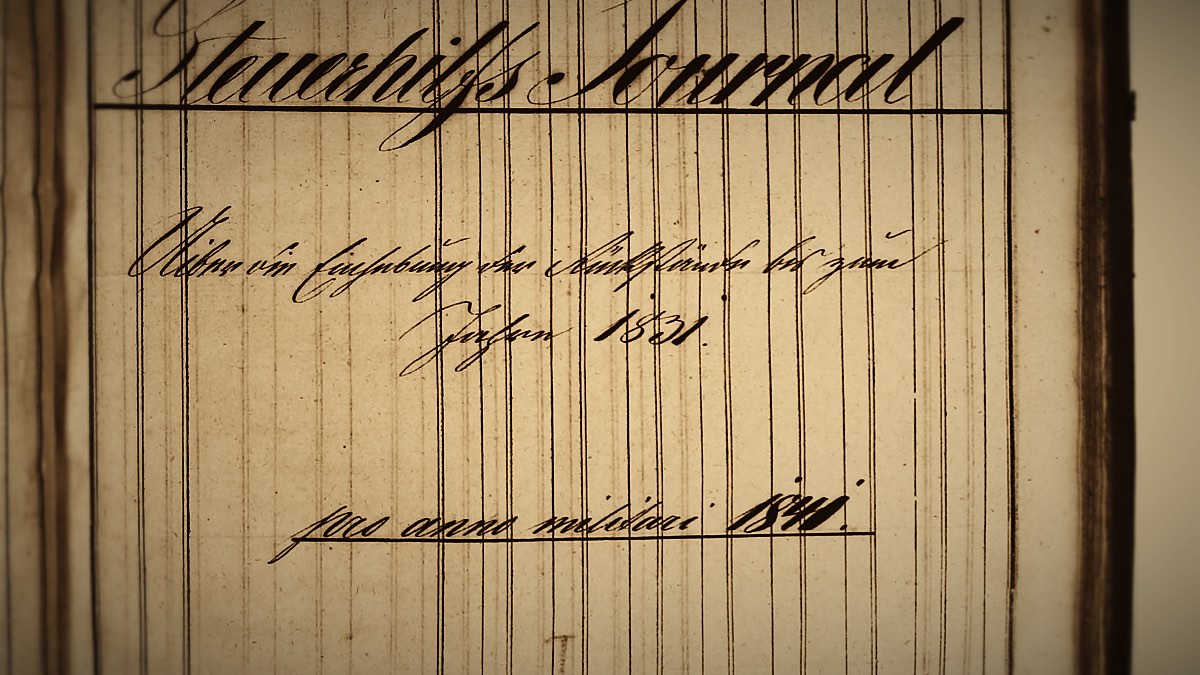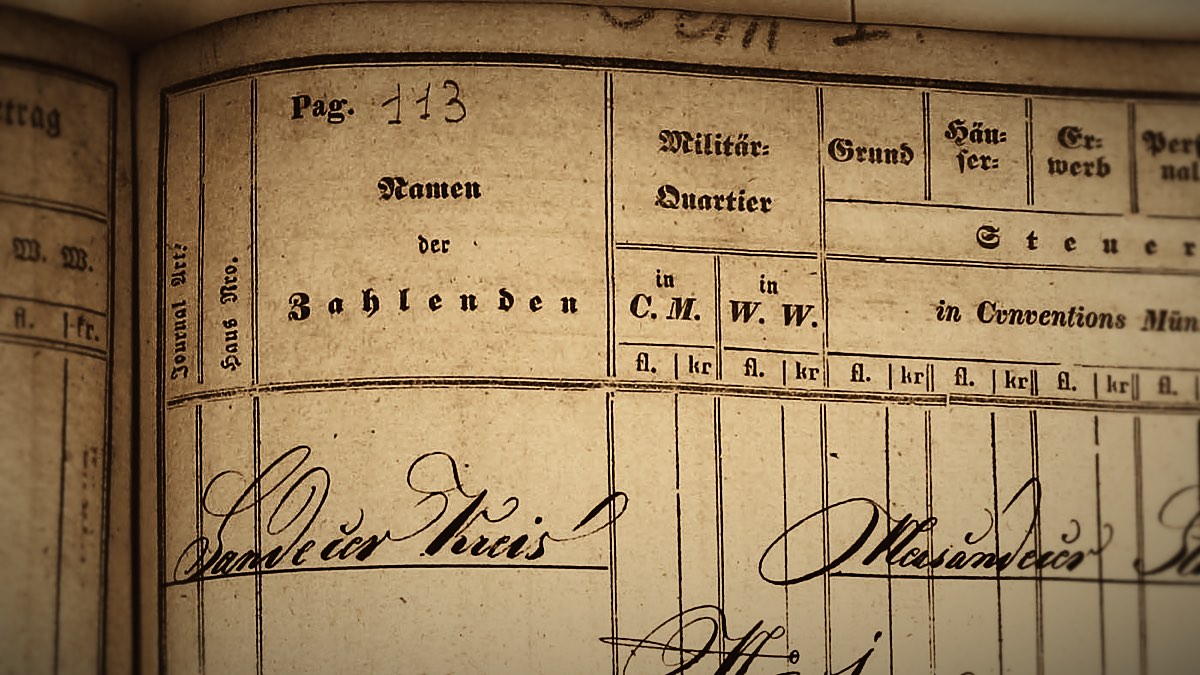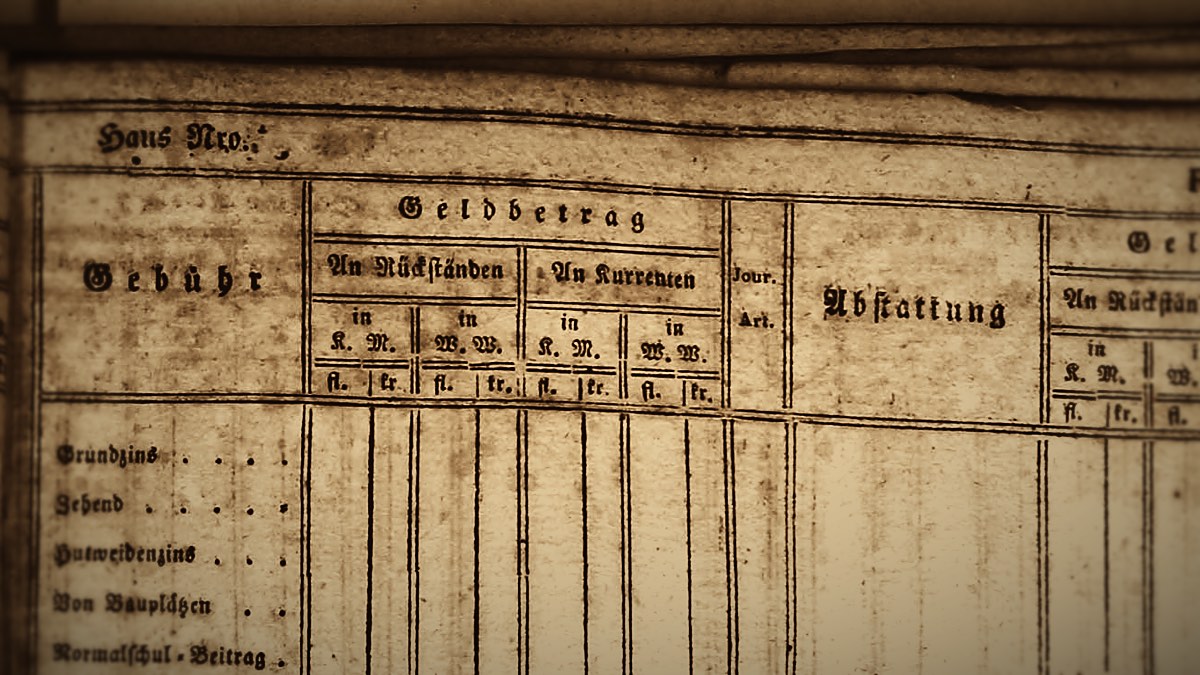
Nowy Sącz, known in Yiddish as Sanz, was a town in Austrian Galicia. Its clerks kept their books in German, and they wrote down the names of the people who paid house tax, trade tax and other dues. Those books are still there, in the Nowy Sącz branch of the National Archive in Kraków (Archiwum Narodowe w Krakowie, Oddział w Nowym Sączu), and they were photographed page by page in the archive's reading room.
This is the story of how those photographs became a list of names you can search, and an honest account of what that list can and cannot tell you.
4,212 photographs
There are 4,212 photographs behind this index. Almost every one shows an open book: two facing pages side by side. They come from 25 archive units of Sanz, record books and bundles of papers. Most of them are the tax journals and account books of the town treasury from 1825 to 1852. There is also a land and house tax register of 1832, town property accounts, loose town papers going back to the 1780s, and a file of correspondence on Jewish matters from 1801 to 1819. One hundred of the images are scans from another archive: a register of the Jewish community of Wieruszów, a different town. Its lines are in the index too.
Not every photograph holds a name. Covers, blank pages and pages of column totals have none. In the end, 3,021 photographs hold at least one name.
Some pages were never photographed. The biggest gap is a run of about 400 pages in the tax journal of 1845; whether they hold entries or are blank is still to be checked. These gaps are written down, so they can be checked on the next visit to the archive.
Old German handwriting
The clerks wrote mostly in German Kurrent, the old German handwriting, and sometimes in Latin letters, or in Polish or Latin. Kurrent is hard going even for people who read German well. A small e and a small n look almost alike. The long s can pass for an f or an h. A u wears a little hook on top. Capital K, V and R are easily confused, and so are ch and ck.
Many of the photographs were also stored upside down or on their side, so the first job for every image was to find which way was up.
Cutting, reading, and putting back in order
The writing on a whole two-page photograph is too small to read well, so each photograph was cut into four quarters: 16,848 pieces in all.
A quick AI reader looked at every quarter first, to find the ones with names on them. Then a stronger AI model read every quarter that had names, line by line: the entry number, the house number, the family name, the first name, any word written beside the name such as Jude or Witwe (widow), the date and the amount. Of the 44,839 names in the index, 44,782 were read by the stronger model.
The reader was given one firm rule:
Transliterate each name letter by letter exactly as written. Do NOT correct it to a name you know.
That rule matters. A reader that "fixes" an unusual spelling into a familiar name would hide exactly the spellings a family historian is looking for.
The readings were then put back in true book order: book, photograph, left or right page, line. Clerks often wrote Derselbe ("the same man"), Dieselbe ("the same woman") or detto instead of repeating a name. 2,694 of these lines are linked to the name written above them, so a search for the family finds them too; a few hundred written in other ways, such as do, d° or Derselben, are not linked yet.
Grouping the names, and a second look
Different spellings of one name were grouped into family names: 8,858 of them in all, which you can browse. An AI pass then marked which names are Jewish, judging from the family name, the first names written with it, and how often the clerk wrote Jude beside it. It marked 941 names, and suggested a Yiddish spelling for each.
For every one of those 941 Jewish names, a second AI pass opened one original picture of the name and read the family name again, letter by letter. In 647 cases it agreed exactly, and in 288 more it came close.
People check the work too. Readings are corrected by hand as mistakes are found, and every correction is kept when the index is rebuilt. For one family, the Kögels, every line was checked by eye against the photographs. And every record page on this site has a form where you can tell us that a name was read wrong.
What the index can tell you
The index tells you that a name was written in these books. When you order a record, you receive the page photograph or the written details of the line: the book and its archive signature, the year, where the name stands on the page, and what the line says, such as the house number, the date and the amount.
The search also helps with spelling. The normal search finds your spelling and names one letter different, and it treats i, y and j, w and v, and ch, ck and k as the same.
What it cannot tell you
- Family relationships. A tax book records who paid, when, how much and for which tax. It never says who was whose son, brother or wife.
- That every reading is right. The reader also said how sure it was of each name. It was sure of fewer than one name in fifty, and unsure of more than half. That is why the page itself, not the index, is the record.
- That every name sits in the right family. Spellings were grouped by machine, and the Jewish names were marked by machine.
- How many people there were. Most lines are a payment, not a person: a man who paid sixteen times has sixteen lines. And where two quarters of a photograph overlap, the same line can now and then appear twice, read two slightly different ways.
- Everyone who lived in Sanz. Only people named in these books appear, and some pages are missing.
If you cannot find your family, ask us and we will look for you. Or start with a search.
The names in the Sanz records were read from old handwriting with the help of AI and can be wrong; the page itself is the record.