Open one of the old Sanz tax books, or a page you ordered from this site, and you see neat columns of numbers beside names in a hand that looks nothing like modern writing. This is a short guide to reading them: what the books are, what each column means, and why one family can be spelled four different ways.
What the books are
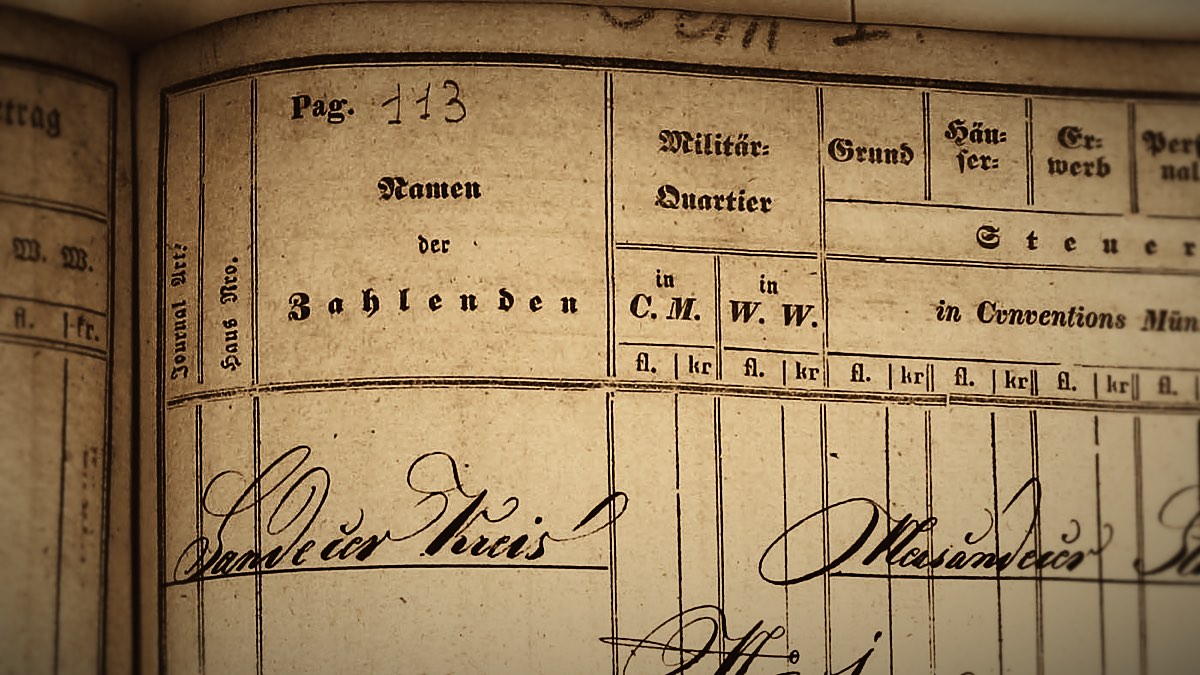
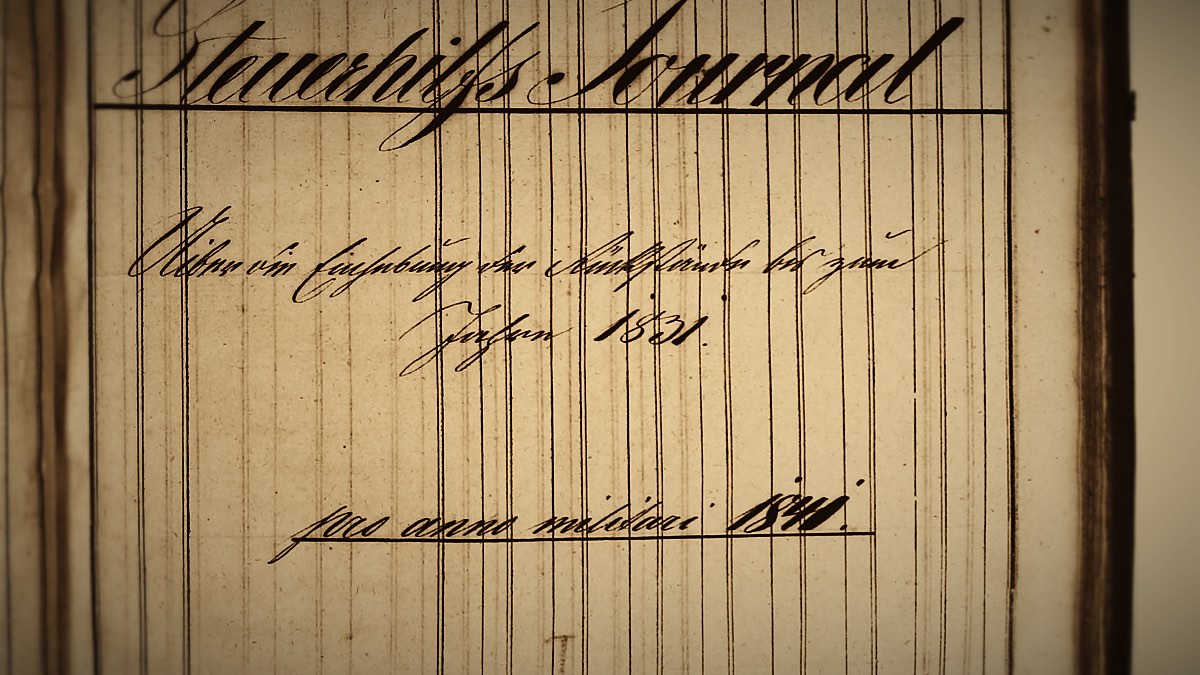
Under Austrian rule the town treasury of Sanz, the Stadtkassa, kept day-by-day cash books of the taxes it received. Their titles are usually some form of Steuer Haupt- und Aushilfs-Journal, the main and supplementary tax journal. Whenever someone came to pay, the clerk wrote a line on that day's page: a running number, the payer's house number, the payer's name, and the sum, set in the column of the tax that was paid.
These journals are the heart of this index. Of its 44,839 name lines, 37,958 come from the tax journals and account books of the town treasury, 1825 to 1852. Beside them stands a different kind of book, the land and house tax register of 1832, with one line for each house in order of the house numbers.
Some journals follow the "military year" (pro Anno Militari), which began in November. The journal for 1829, for example, runs from November 1828 to October 1829. So a payment in a book labelled with one year may have been made late in the year before.
The columns, one by one
Journal-Artikel (also Jour. Art. or Post) is the running number of the entry. Clerks sometimes wrote only its last digit, so a short number on its own can mislead.
Haus-Nro. is the house number. Be careful with the earliest books: in the journals of 1825 and 1827 this column is headed Steuer-Buch Pag., a page in the tax register, and only from 1828 is it plainly a house number. Some people, though not all, stand at the same numbers before and after the change, which suggests that the register followed the house numbers, but it is not proof.
Namen der Zahlenden, "names of those paying", holds the name. Usually the family name comes first and the first name second, as in Kugler Wolf; sometimes it is the other way round, as in David Kegel.
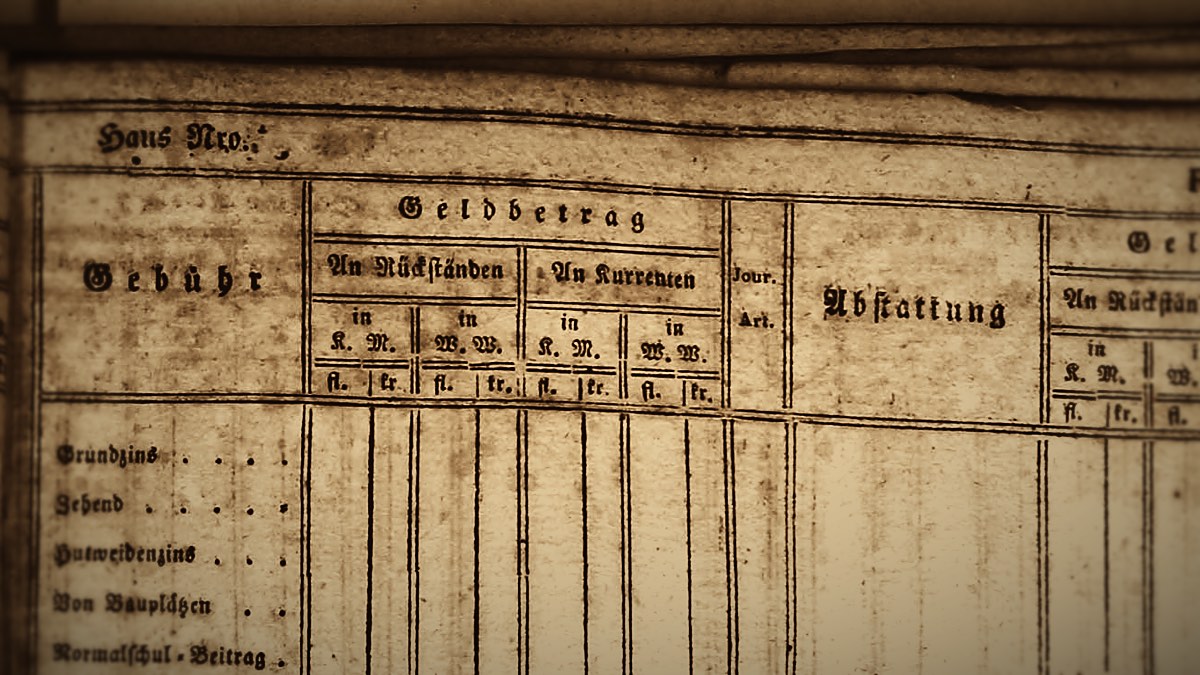
Then come the money columns, one for each tax: Personalsteuer (personal tax), Häusersteuer (house tax), Erwerbsteuer (trade tax on a craft or business), Grundsteuer (land tax), and smaller levies such as the contribution for the district roads (Kreis Straßen) and Militär-Quartier.
The money is in gulden (fl.) and kreuzer (kr.), with 60 kreuzer to the gulden. The books show it themselves: 40 kr and 40 kr are added up to "1.20". Two currencies were in use, Conventions-Münze (C.M.) and Wiener Währung (W.W.). At the official rate, one gulden C.M. was worth two and a half gulden W.W.
The clerk's shorthand
- Derselbe ("the same man"), Dieselbe ("the same woman"), detto, do or d° mean "as in the line above". The index has linked 2,694 such lines to the name above them, so they appear under that family. About 300 more, mostly written do, d°, dt or Derselben, are not linked yet, so look at the line above on the page.
- Years with three digits. "825" means 1825. Thousands of dates in the index are written this way.
- Months by number. 7ber is September, 9ber November and Xber December.
- pro 831 means "for the year 1831". People often paid for an earlier year, so the year of the book and the year of the tax can differ.
- Erben after a name means "heirs": the line is in the name of the payer's heirs.
- Witwe means widow and Jude means Jew. Clerks added such words now and then, not every time.
Then there is Kurrent itself, the old German handwriting. A small e and n look alike, the long s resembles f or h, a u wears a small hook on top, capital K, V and R are easily confused, and so are ch and ck.
Why spellings vary
The clerks wrote names as they heard them, and the same name could come out differently from one entry to the next.
Take the family listed on this site as Kögel (Kugel). In one journal of the late 1820s, very probably the same man at the same house is written Kugler in one entry and Kögel a few months later. Another man at the same house, David, appears once as Kegel, and in some years the name is plain Kogel, without the two dots. Four spellings, very probably one family, at one house. On this site all of these lines are listed under Kögel; the page photo shows how each one was actually written.
Or take Blech and Bleich. Our list shows them as two names, and the spelling alone cannot tell us whether they are one family. Yet the same first names, Jacob and Joel, appear under both spellings in the same decades. That is a hint, not a proof. The normal search finds both, because the two spellings are only one letter apart.
Other differences come from habits of language. Polish spelling shows through in Szwarz beside the German Schwarz. The letters i, y and j change places freely, so Sinay also appears as Synay and Sinaj. And some differences are not the clerk's at all, but misreadings of hard handwriting. That is why the page photo is always the final word.
What a family historian learns
A tax journal will not draw your family tree, but it gives you solid ground to build on.
- Where they lived. A house number ties a family to one house, often for many years, and the names on the same page show you their neighbours.
- When they were there. A person's first and last payments mark out the years in which they paid tax in Sanz.
- What they had. House tax suggests a share in a house; trade tax suggests a craft or business. Both are hints, not proof.
- When something changed. When a name is suddenly followed by Erben, the payer had probably died not long before. A clerk could keep writing a name for a while after a death, so treat it as a clue, not a date.
- The women. Widows and other women appear in their own names as payers.
What a tax book never says is who was whose child, brother or wife. For that you need birth, marriage and death records. But once you know a family's house and years from the tax books, those other records become much easier to find.
Start with a search, or browse the family names.
The names in the Sanz records were read from old handwriting with the help of AI and can be wrong; the page itself is the record.